This video might be more for my students’ parents than for my students. However, I was thrilled to find it, and want to share it!

This video might be more for my students’ parents than for my students. However, I was thrilled to find it, and want to share it!
Posted in Uncategorized
While researching biographical information on Isaac Newton, my students found conflicting dates for the scientist’s birth (December 25, 1642 and January 4, 1943). This is due to a difference in the Julian and the Gregorian calendars. At the time of Newton’s birth, England had not yet adopted the Gregorian calendar, so there is an “old” date for Newton’s birth and a “modern” date. (England changed calendars in 1752.)
Our modern western calendar seems like a fixed, unvarying system of measuring time, but it’s actually the result of lots of science and lots of tinkering. This great little video helps explain:
Some people think our calendar needs to be overhauled again. This article in Scientific American suggests the calendar could be revised to be more business-friendly.
Posted in Uncategorized
While the miniature movie, “Dot,” is cute and engaging, the technology behind the film was developed to address serious medical needs. The CellScope’s inventor explains how the technology has been used to diagnose malaria. Malaria infects millions of people every year, killing close to a million of them. It is carried by mosquitoes. According to the World Health Organization, on the African continent, a child dies of malaria every 45 seconds.
Posted in Uncategorized
The tiny little movie “Dot,” which is the world’s smallest stop-motion animation, is always a hit with my students when we begin to study microscopes. Here, Dot’s creators explain the process they used to make the minature film.
Posted in Uncategorized
Talk about tiny, Dot is only a third of an inch tall!
Using a Nokia N8 smartphone and a CellScope, the team behind the Wallace & Gromit films has made the world’s smallest stop-motion animation film.
They made it to help celebrate the invention of the CellScope,  a tiny hand-held microscope invented by a scientist at the University of California-Berkeley. It allows doctors to view and record things like ear aches and sore throats. It is basically a 50x magnification lens on a cellphone camera. (You can read more about it here.)
The animators also used a 3D printer to make 50 different versions of Dot, because she is too small to bend like they would other stop-motion animation characters. The figurine’s tiny features stretched the limit of the printer — any smaller and it would be hard to make distinct limbs. Each version of Dot was hand-painted by artists looking through a microscope.
Posted in Animation, Medicine, Microscopy, Technology
Discarded fishing nets are clogging our oceans, posing threats to marine life both small and huge.
Posted in Ecology, Marine Biology
Robert Krulwich has one of the best jobs in the world. He’s a science reporter for NPR (National Public Radio). His specialty is taking complicated information and explaining it in simple terms that almost anyone can understand.
Today, on his NPR “sciencey” blog, he answers the question, “How much does a hurricane weigh?” The answers come in new units of weight – elephants and blue whales!
Posted in Meteorology, Nature
Tagged animation, cartoon, hurricane, npr, robert krulwich
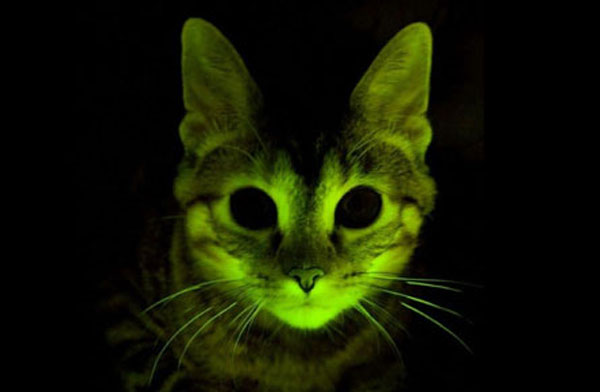 Medical researchers at the Mayo Clinic have developed glow-in-the-dark kitties as part of their search for a gene therapy that might cure people with AIDS.
The technique is called gamete-targeted lentiviral transgenesis. This is a fancy way of saying that genes were inserted into the eggs of female cats before they were fertilized. In this case, the team inserted a rhesus monkey gene that is known to block cell infection. The gene specifically blocks infection by FIV, or feline immunodeficiency virus, a virus similar to the human virus that causes AIDS. In the process, the researchers also inserted a jellyfish gene for tracking purposes. The jellyfish gene makes the kittens born from these altered eggs glow green.
This is the first time this sort of gene implant has succeeded in a carnivore.
Posted in Medicine


Click the photo above to watch live penguins on the California Academy of Sciences Penguin Cam
 My Science Mind