(Thanks to Bill Nye, The Science Guy for this!)

To promote its new movie, Contagion, Warner Brothers commissioned the creation of living billboards. Infected with fungi and bacteria spread on giant petri dishes, the billboards blossomed in warm Toronto windows.

The billboard after five days of growth.
Posted in Microbiology
In the United States, we have a lot of stuff. Where does all our stuff come come? Where does it go? The Story of Stuff Project helps explain. This video was produced by the folks at the Project, an non-advertising driven, donor-supported project educating the public about the realities of consumerism. There are other great little films, too, such as The Story of Cosmetics, The Story of Electronics, and The Story of Bottled Water.
Posted in Ecology
We’re talking about recycling in my science classes. Helping our students understand the importance of recycling will help us have a cleaner campus all year and a cleaner Earth into the future. Most people don’t realize that plastic is a major source of water pollution. This video by KQED does a great job of outlining the problem with plastics.
Posted in Ecology, Marine Biology
Capt. Charles Moore of the Algalita Marine Research Foundation first discovered the Great Pacific Garbage Patch — an endless floating wasteland of plastic trash. Now he’s drawing attention to the growing, choking problem of plastic debris in our seas.
Posted in Ecology, Marine Biology
Jellyfish Lake is on the island of Eil Malk, part of the island nation of Palau, in the Pacific Ocean.
Twelve thousand years ago jellyfish became trapped in a natural basin on the island when the ocean receded.
Because there were no predators of the jellyfish for thousands of years, they evolved into a new species that lost most stinging ability because they no longer had to protect themselves. Now, they are pretty much harmless to humans although some people with very sensitive skin may get a minor irritation from them.
Snorkeling near the surface of Jellyfish Lake is a popular activity for tourists in Palau. Scuba diving is not allowed because the bubbles are harmful to the jellyfish, and because diving into the lower depths of the lake is very dangerous. While the top layer of the lake is oxygenated, the lower part, which starts about 49 feet down, is anoxic (without oxygen) and contains a bacteria that absorbs all light. Additionally, the deeper water is very high in hydrogen sulfide, a toxic gas that divers can absorb through their skin.
Posted in Uncategorized
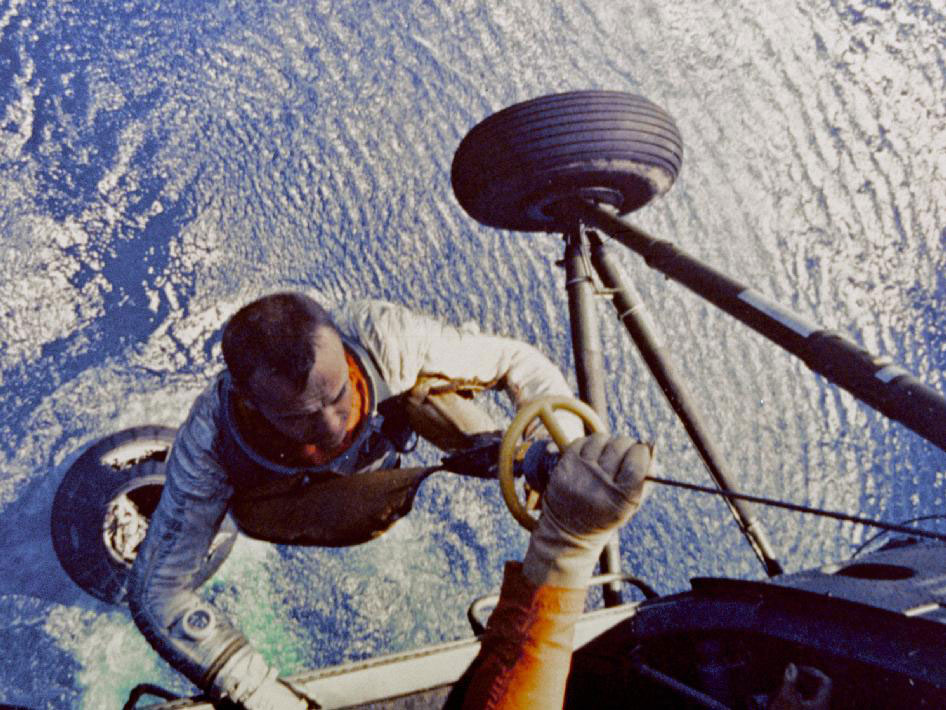 On May 5, 1961, NASA astronaut Alan Shepard piloted his Freedom 7 Mercury capsule in a 15-minute suborbital flight, becoming America’s first astronaut. In this image, he being hoisted aboard a U.S. Marine helicopter after splashdown. The flight carried him to an altitude of 116 miles.
This short film of a chess game brought to life was created using the stop-motion photography technique called “clay animation“. In this type of animation, all of the movement is created by people modeling the clay by hand. Then each change is briefly filmed with only one or two frames. It usually takes 12 changes of position to make one second of film. That means that this tiny film, which lasts 111 seconds, has 1,332 position changes!


Click the photo above to watch live penguins on the California Academy of Sciences Penguin Cam
 My Science Mind