Holy human-powered flight, Batman!

A Canadian man has become the first human to fly by flapping wings, according to the Toronto Star.

Todd Reichert is an engineer, studying for his PhD at the University of Toronto Institute for Aerospace Studies. He both designed and flew the craft, which is called an ornithopter. Ornithopters are flying machines that are heavier than air and powered with flapping wings, in imitation of birds.

Reichert named his ornithopter “Snowbird”. The machine is built out of balsa wood and carbon fiber – two very light substances. Although Snowbird has a 105-foot wingspan, which is just six feet shorter than the wings of a Boeing 737 jet, the ornithopter only weighs 94 pounds.

Snowbird was towed by an SUV to takeoff (much like you would run with a kite to get it in the air). Then, with Reichert peddling like crazy, the wing-flapping device sustained altitude for 19.3 seconds and carried him 475 feet with an average speed of 16 miles per hour.  The Toronto Star doesn’t say how he landed.

Reichert has now filed a claim for a new world record in human-powered flight.

Here is some historic footage of early attempts at human-powered flight:

Why today’s equinox is special

Click on the illustration above to visit the National Geographic website, where you can see a short video about equinoxes.

In Northern California, Fall will officially begin at 8:09 this evening, with an astronomical event called an equinox.  This equinox is special because it will also occur on the same night as a full moon. This is the first time these two things have happened together since 1991. Traditionally, the full moon closest to the September equinox is called the Harvest Moon.

An equinox occurs twice a year. The first day of Spring (which happens in March) is called the Vernal Equinox, and the first day of Fall (today) it is called the Autumnal Equinox. The first days of Summer and Winter are called solstices.

During an equinox, Earth’s axis points straight toward the sun. It doesn’t tilt away from, or toward, the sun. In this way, the center line of the sun is directly over the center line of the Earth, or the equator.

Because equinoxes happen when two round objects align – the Earth and our sun – they actually happen at different times around the globe. The time for an equinox is first calculated in Coordinated Universal Time (UTC) which is standardized for the entire Earth, based on atomic time and adjusted for the Earth’s rotation. However, you can use a seasons calculator to figure out exactly when the equinox is happening in different parts of the world.

Today, in the United States, many people won’t notice or celebrate the equinox. However, in ancient civilizations, astronomical events such as equinoxes and solstices were very important. Entire monuments were built to help people appreciate how big and special these celestial events are. In some cultures, these events are still celebrated. (Watch the National Geographic video to learn more)

Physicists see new things at the Large Hadron Collider

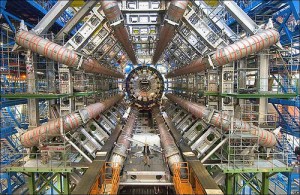
The Large Hadron Collider is a 16.8-mile-long (27-kilometer) circular particle accelerator buried under the French-Swiss border. There, deep under ground, scientists are using the giant machine to  recreate  powerful but microscopic bursts of energy that mimic conditions close to the Big Bang that created the universe.

There are about 7,000 particle physicists in the entire world and half of them work at the Large Hadron Collider (LHC).

Now these scientists have announced that results from one of the detectors in the LHC indicated that “some of the particles are linked in a way not seen before in proton collisions,” the European Organisation for Nuclear Research (CERN), which runs the collider,  said on its website.

Sometime around the middle of July, the phenomenon showed up on computer mapping graphs based on data from billions of proton collisions happening in the collider. Scientists on the project are very excited about this new development because the 5.2 billion (yes, that’s billion!) dollar machine was built to help find physical evidence of things in the universe that haven’t ever been seen.

The discovery happened during one of six experiments that are on-going at the collider. This experiment is searching for the Higgs Boson. Although scientific experiments and calculations point to the existence of this tiny particle, it hasn’t been proven to exist like protons, neutrons, and electrons have. There are other known particles, too, including some called “bosons,” but this one remains hidden. If the Higgs Boson exists, it would be the opposite of rare. It would be all over the universe, in almost every kind of matter.

The science of particle physics studies the tiny bits that make up the elements of the universe.  The Standard Model is used by scientists to describe many particles, including the Higgs Boson. However, it is the only particle in the model that hasn’t been proven to exist.

Scientist think there is a 50 to 95 percent chance they will be able to prove the existence of the Higgs Boson. You can bet that if that happens, there will be some very happy scientists!

Large Hadron Rap explains it all

If rappers wear lots of gold chains, what do science rappers wear? Protein chains? Reaction chains? Cross-linked polymers?

Kate McAlpine, 25, is a science writer working for CERN. Her rap video about the Large Hadron Collider called the “Large Hadron Rap” is an internet hit, having attracted more than 6 million viewers. Scientists say she does a great job of explaining complex ideas in a fun way.

If you want a crash course in how the super collider works, check out her “Large Hadron Rap”:

Named Magellan: An explorer, a spacecraft, and more

It was on September 20th in 1519 that Ferdinand Magellan set sail from Spain on the first successful attempt to sail all the way around the world. The word “circumnavigate” is used to describe this feat.

A native of Portugal, Magellan sailed under the Spanish flag with a fleet of five ships and 237 men.

As a result of his successful voyage, his name has come to represent exploration and navigation. NASA launched the Magellan spacecraft in May 1989, on an unmanned exploratory flight to Venus. It arrived at its destination in August of 1990, and for several years, it flew in an orbit around the planet. Cameras on board Magellan took pictures of Venus, enabling scientists to map 98 percent of the planet’s surface.

Scientists are particularly interested in Venus because they believe it to be the planet in the solar system most like our own, Earth.

The Magellan spacecraft’s mission ended with a dramatic flourish when scientists on Earth ordered it to crash-land on the planet’s surface. This allowed the spacecraft to gather data on the planet’s atmosphere on the way down.

Like the Magellan spacecraft, Ferdinand Magellan didn’t make it home, either. He was killed in a battle in the Philipines during his expedition. While he didn’t actually finish circumnavigating the globe, his fleet did. However, only 18 of the 237 men who originally started out on the voyage finished the trip. They arrived home in 1522.

Other things named after Magellan include the Magellanic Clouds, which are dwarf galaxies; the Magellanic Penguin, which he first observed and recorded during his voyage, and a GPS system.

Zoo finds a “new” 3 million-year-old whale

Allen J. Schaben of the Los Angeles Times took this picture of the whale skeleton

A construction crew was digging a hole for a storm-water runoff tank at the San Diego Zoo, when the excavator suddenly hit something in the dirt that made a scraping sound.

It turns out there was a fossilized 3 million-year-old whale skeleton under all the living animals at the zoo.

When the skeleton was uncovered, a paleontologist from the San Diego Natural History Museum was already at the construction site, acting as a sort of “fossil monitor”. Often, big construction projects with a lot of excavation are required to have a paleontologist check the site to make sure historical artifacts aren’t being destroyed by digging.

The paleontologist heard the sound and the digging stopped. California state law requires that construction be halted when something of fossil, or archeological, interest is uncovered. This is to give experts time to examine the site and make arrangements to preserve and move their findings.

More paleontologists from the museum were called, and within a day, the group was carefully chipping, dusting, and digging. The skeleton will be encased in plaster at the site and taken back to the museum for additional study.

Meanwhile, work on the storm-water project resumed.

Paleontologists had expected that digging at the site might uncover some minor fossils. But finding a whole fossilized whale , particularly one 20 feet long and largely intact, was unexpected.