Astronaut aims to break duration record

Astronaut Mike Fincke will serve as a mission specialist aboard Space Shuttle Endeavour‘s final flight which is scheduled for today at 3:47 Eastern Time. On this, his first (and last) Space Shuttle Mission, Fincke is set to break a record – the record for days spent in space by an American.

Before Endeavour returns home from her final voyage, Fincke will have surpassed astronaut Peggy Whitson’s existing record of 377 days in orbit.

Although this is Fincke’s first trip aboard a shuttle, he has twice  visited the International Space Station on Russian Soyuz spacecraft.

The Space Shuttle program, which started in the 1960s and made its first flight in 1981 (Columbia), will end June 28 with the launch of Atlantis.

This may be the tallest cliff in the solar system

Photo: Voyager 2, NASA (1986)

Verona Rupes on Uranus‘ moon, Miranda, is estimated to be more than 12 miles deep – ten times the depth of the Earth’s Grand Canyon (which is slightly more than a mile deep).

Because of Miranda’s weak gravity, if a person jumped from this cliff, it would take 12 minutes before they hit the bottom. Sounds like a slow, gentle trip, right? Wrong. By the time they reached the bottom, they would be traveling at the speed of a race car – about 125 miles per hour!

This photo of Verona Rupes was captured by the passing Voyager 2 robotic spacecraft in 1986. How the giant cliff was created remains unknown, but is possibly related to a large impact by a meteor or other celestial body, or tectonic plate motion on Miranda’s surface.

Banana Slugs, Unpeeled

Watch this short feature on one of the forest’s unsung heroes and find out what makes the Santa Cruz banana slugs special:

Nest cam offers view of falcons

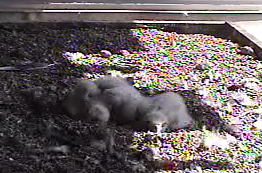
These are George and Gracie's chicks waiting for an adult to bring their next meal. Click on the link at the end of this post to visit the live falcon cam.

George and Gracie are a pair of peregrine falcons that like to nest on building ledges high above the bustle of San Francisco’s streets.

Their romance is a success story.

Until 2009 peregrine falcons were endangered in California. The recovery of the peregrine falcon population is a very rare success. This is only the second time a species has been removed from the state’s endangered list. The falcon population had diminished because of human disturbance and shells thinned by the pesticide DDT (which was banned in the United States in 1972). The chemical accumulated in the birds’ food, contributing to thinner eggshells that were often crushed when the adult birds sat on them during incubation.

At the time DDT was banned, only about five nesting pairs of peregrines remained in California.

Now the California Department of Fish and Game says the peregrine population is at an historic high, and the birds once again occupy their old habitat on the cliffs of California. Additionally, they have also adapted to city living, where they are welcome residents. Among other prey, peregrines eat pigeons, which are pests in many cities.

Peregrine falcons are about the size of a crow and are known for their speed and precision when flying. They can catch smaller birds in the air in spectacular, precise, hunting dives called “stoops”. While in a hunting stoop, some birds have been clocked at 200 miles per hour!

You can visit George and Gracie courtesy of a live falcon cam  that is a project of Santa Cruz Predatory Bird Research Group. Their eggs have hatched and their chicks are in the nest now. Click this link to visit their nest! There is also an interesting diary of the nest’s activities you can read here.

A tiger cub being born

From National Geographic‘s Expedition Week television special Tiger Man of Africa: The Mating Game, big cat conservationist John Varty closely observes as one of the 15 tigers at his Tiger Canyons reserve gives birth.

Note: This video contains rather graphic footage of a tiger being born, although it’s really cool and not that icky!

The northern lights in time lapse

The northern lights, properly called the aurora borealis, are a natural light display in the sky caused by charged particles in the atmosphere being pulled around by the Earth’s magnetic field. When the particles collide and release energy, the lights appear.

This natural phenomenon is usually most apparent near the Earth’s poles (in the southern hemisphere it is called aurora australis, or “southern lights”) and especially near the equinoxes . Equinoxes are the time of year when the Earth’s axis tilts neither toward the sun (summer), nor away from it (winter). We think of the two annual equinoxes – the Vernal, or Spring Equinox, and the Autumnal, or Fall Equinox – as the beginnings of those seasons.

The auroras get their names from Aurora, the Roman goddess of the dawn. Various kinds of auroras can be seen all over the world and on other planets, too.

Norwegian landscape photographer Terje Sorgjerd spent a week in northern  Norway, near the Russian border, in 13 degree below zero weather, to make this magnificent time-lapse video of the aurora borealis. Other than time-lapse, there are no other special effects in this video – just an amazing light show provided by Mother Nature!

Nikola Tesla – genius and inventor

Marble machines

This video is just plain fun… a whole collection of handmade continuous motion marble machines. It’s mesmerizing!

Electromagnetic spectrum sing-along

This song and video, made by two industrious guys in Singapore, is a fun way to learn about the electromagnetic spectrum. It’s not particularly grammatical or tuneful, but my classes love it and I’d give it an “A” for a great effort! (Careful! It can get stuck in your head pretty easily!)

The Inner Life of the Cell

Often the illustrations in textbooks depict cells as flat, like a fried egg. I am always reminding students that cells are three-dimensional. Like a balloon or a bubble, they have space inside. This is where the business of the cell happens and where the organelles live, surrounded by cytoplasm.

This incredibly beautiful animation depicts the inner workings of a eukaryotic cell. Harvard University selected the scientific animation company XVIVO to develop an animation that would take the university’s cellular biology students on a journey through the microscopic world of a cell.

This award-winning piece was the first topic in a series of animations XVIVO is creating for Harvard’s educational website BioVisions at Harvard.