Harry Potter sings The Elements song

I know that The Elements Song by Tom Lehrer was a big hit with some of you. What’s even better? How about Daniel Radcliff, of Harry Potter movie fame, singing his way through the periodic table?

Let fingers do the talking

In this very cool little film, British animator Cyriak uses fingers to tell a quick version of the story of life on Earth.

Dr. Bugs births a baby

I don’t know if studying bugs make some people buggy or if they’re just born buggy to study bugs… but I will warn you that Dr. Bugs, or Mark Moffett, as he’s known to some, has a love of bugs that is bigger than some of us might find reasonable. The ecologist, explorer, and photojournalist recently let a bug hatch from the back of his hand. Warning: There are several things in this video to make you squeal, but don’t let that keep you from watching all the way to the end.

New microbe defies “law” of life

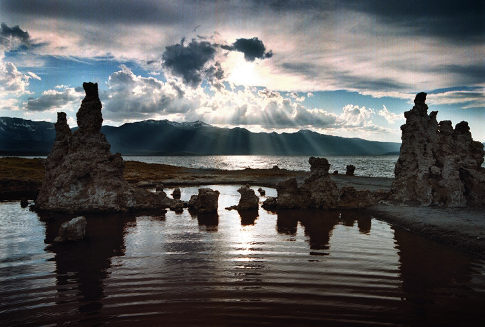
California's Mono Lake

There was big news from NASA today.

A team of scientists from NASA’s Astrobiology Institute and the U.S. Geological Survey in Menlo Park, Calif., announced it has found a microbe that exists in a way that was never thought possible.

Felisa Wolfe-Simon

The group, led by Felisa Wolfe-Simon, has found a bacterium that “eats” and uses toxic arsenic,  substituting the arsenic for phosphorus in its essential functions, including building new cells.

In all lifeforms that scientists have studied so far, the “backbone” of DNA is made of sugar and phosphorus in the form of phosphate. In this microbe, arsenic bonds with the sugar to make a new type of DNA.

This is a really big deal. As most science students know, there are six elements that are thought of as the “building blocks” of life – carbon, hydrogen, oxygen, nitrogen, phosphorus, and sulfur. (Sometimes they are written like this: CHONPS.) When scientists consider whether other environments may be hospitable to life – like another planet, for example – one of the things they consider is the availability of CHONPS.

This new microbe was found in mud from the bottom of California’s Mono Lake. Mono Lake is located in the eastern part of the Sierras. The lake is volcanic in origin, and now a closed basin, meaning no rivers or streams feed it fresh water, and none carry water away from the lake. (Once upon a time, the lake had feeder streams, but they were diverted by the Los Angeles Department of Water and Power and the lake was left to dry up and die.) As a result, all of the minerals and substances naturally found in a lake are very concentrated there. Mono Lake is almost three times as salty as the ocean. It is highly alkaline and rich in carbonates, phosphorus, arsenic and sulfur. It is filled with shrimp, flies and algae that can survive the lake’s strange chemistry.

So what makes NASA so interested in stuff on the bottom of a lake? Well, think about it this way: When astrobiologists look for life on other planets, they usually look for planets with environments like Earth, that include CHONPS. Now they can now vastly expand their searches to include other places and planets.

“We’ve cracked open the door to what’s possible for life elsewhere in the universe,” said Wolfe-Simon. “What else might we find?”

Resources:

Here is a bigger story about the microbe’s discovery in the New York Times.

Here is a great website for learning more about Mono Lake, including its geological and human-influenced histories.

Nature’s transformer

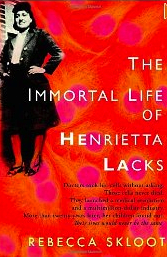
Book Review: The Immortal Life of Henrietta Lacks

A Life Both Wasted and Immortal

(Note: This book contains adults themes such as child abuse, incest, and venereal disease in a factual telling of a family’s history. These themes are neither detailed or glorified.)

I first heard about Rebecca Skloot’s book, The Immortal Life of Henrietta Lacks, in an episode of RadioLab, a science program that is broadcast on public radio stations, and is also available in podcast form. (If you’ve never heard RadioLab, I highly recommend it.)

Henrietta Lacks was a very poor, uneducated African American woman who lived in the south. She was raised in a family of tobacco farmers, and for much of her childhood lived in the same “home-house” that her family had lived in as slaves. She was, quite literally, born on the dirt floor of that home.

Although Henrietta Lacks died in 1951, she had what may have been the greatest influence on science of any woman who has lived. And, this happened without her knowledge or consent.

Continue reading

The “Time Eater”

The Corpus Clock is a large sculptural clock installed at street level on the outside of the Taylor Library at Corpus Christi College, Cambridge, England.

If it looks like a clock from a nightmare, it’s because the inventor meant it to be scary, emphasizing his idea of time as a constant pressure on human lives.

The Corpus Clock, which has been called “the strangest clock in the world,” was conceived, designed, and funded by inventor John C. Taylor, and theoretical physicist and cosmologist Stephen Hawking participated in its public unveiling.

The horological masterpiece features a time-devouring grasshopper, or what the inventor calls a “chronophage,” or “time eater”, at its top that crawls forward one second at a time. As it moves, the 60 slits cut into its face light up to show the time. It took a team of eight engineers and craftsman five years to mold the clock. It is expected to run another 25 years on its current electric motor.

“Conventional clocks with hands are boring,” Taylor says. “I wanted to make timekeeping interesting.”

New animal discovered

Madagascar is an island nation in the Indian Ocean off the southeastern coast of Africa. The main island, which is also called Madagascar, is the fourth-largest island in the world.

Because Madagascar is isolated in the middle of the ocean, plants and creatures evolved there separately from the rest of the world. As a result, Madagascar is home to many species not seen anywhere else. For example, 75 percent of the animals there live nowhere else in the world. (See some of them here.)

Now, scientists have found and identified another animal on Madagascar.

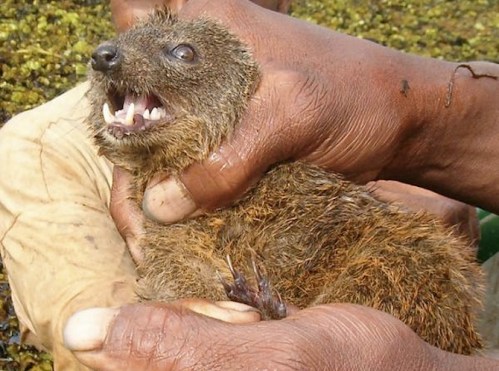
An mongoose-like creature has been discovered living in the in the country’s wetlands. It is a cat-sized carnivore with wicked-looking teeth.

Because it was discovered by researchers from the Durrell Wildlife Conservation Trust, founded by naturalist and author Gerald Durrell, the new animal has been named Salanoia durrelli, or the Durrell’s vontsira.

That the vontsira would be found on Madagascar is unsurprising. While most new land-dwelling species are small and easily overlooked, tropical jungles, like those on Madagascar, contain Earth’s last few unexplored areas.

Unfortunately, the wetland home of the Durrell’s vontsira is threatened by agricultural expansion. Conservationists say that protection is urgently needed for the vontsira to survive.

The elements on Google

Tom Lehrer is a singer-songwriter and mathematician who became well-known in the 1950s and 60s for writing off-the-wall smart songs. This little animation uses one of his well-known songs in which he sings the names of the elements on the periodic table. The tune is the “Major-General’s Song” from Gilbert and Sullivan’s light opera, Pirates of Penzance. Screen shots from Google illustrate the song, making it fun to watch, and at the same time, showing how useful Google is as a research tool.

Otters threatened by toxic algae

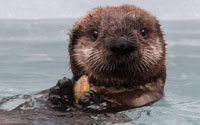
Kit is an otter that was stranded as a pup. She now lives at the Monterey Bay Aquarium.

For several years now, dead otters have been puzzling marine biologists. The mystery began in 2007 when nearly a dozen otters mysteriously died in Monterey Bay. Their carcasses were taken to the California Department of Fish and Game laboratory in Santa Cruz for analysis.

It turns out the otters are being poisoned by a microbe, a type of cyanobacteria that appears to be on an upsurge in warmer, polluted waters around the world. Cyanobacteria are commonly called blue-green algae, blue-green bacteria, and Cyanophyta. They are a type of algae that get their energy from photosynthesis, and their name from their vivid color – cyan.

This particular cyanobacteria is called Microcystis, and it’s not new or rare. It’s an ancient ancestor of modern-day bacteria and algae, and it dominated the planet more than 2.5 billion years ago. Scientists have found that strains of it are reappearing in stagnant water polluted with nitrogen from agriculture, and waste from human activities. It’s been found in water in every country in the world.

Microcystis is absorbed into the tissues of shellfish in contaminated water. There it remains, becoming more than 100 times more concentrated that it is in the surrounding water. Otters eat the shellfish and get sick and die.

The otter population off the California coast has dropped in recent years, which means that adult otters are dying faster than baby otters are being born.

California’s otters were hunted, almost to extinction, by fur traders in the early part of the 19th century. Otter fur had long been prized by Native Americans and other cultures for it’s incredible warmth and softness. Otter fur soon became in demand as a luxury item in many parts of the world and otters were hunted until they were almost entirely wiped out.

The rebound of the otter population on the North Coast has been an ecological success. However, they are still an endangered species and are always subject to threats such as sharks, watercraft, parasites, and food shortages.

Right now, there are about 2,700 otters living on the California coast.

The discovery that the algae is killing otters was made by Melissa Miller, a state wildlife veterinarian who has been tracking the mysterious deaths like a detective. (Visit her website here.) You can read more about how she made this important discovery in this fascinating article in the Los Angles Times.